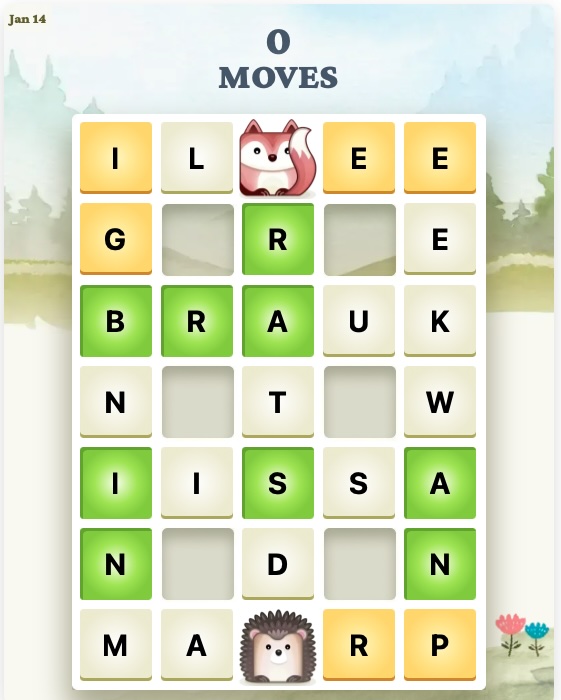
Reunion Introduction
Merriam-Webster’s Reunion is a free online word puzzle hosted on the Merriam-Webster website. Unlike classic word-search or crossword games, Reunion challenges players to rearrange letter tiles on a grid to form valid words in both rows and columns, earning stars by solving with as few moves as possible. While it doesn’t have a long historical lineage like Scrabble or Boggle, it fits into the modern family of daily word-puzzle games that test vocabulary and spatial reasoning.
Rules of Reunion
Reunion presents a grid filled with scrambled letter tiles and two special animal tiles (a fox and a hedgehog). Your goal is to drag and reposition tiles so that every row and column forms valid words and every letter tile ends up in its correct spot, at which point the tile turns green.
Here’s what you need to know:
- Form Words: Create complete, continuous valid words in horizontal and vertical lines.
- Tile Colors: Green means the letter is in the correct location; white and yellow indicate a tile still needs adjustment to fit somewhere in that row or column.
- Animals as Markers: The fox and hedgehog split rows or columns — meaning some may contain two separate words. Completing the puzzle eventually reunites them on the board.
- Scoring: Fewer moves earn higher ratings (up to three stars typically for solving in under ~20 moves).
Reunion updates daily with a new puzzle, giving players a fresh challenge every day.
Reunion Strategy
Reunion isn’t just about knowing lots of words — it’s about placement and planning:
Start with Certainties
Move the letters you recognize first to spots where they must belong based on current feedback (especially green tiles). This reduces ambiguity early.
Use Color Hints Wisely
Yellow and white feedback gives valuable clues: yellow means the letter does belong in that row/column somewhere, so focus on shifting it toward potential correct spots.
Look for Grid Patterns
Scan for common letter clusters or endings (like -ING or -TER) that might anchor words, then build around those.
Think Two Moves Ahead
Avoid unnecessary back-and-forth on the same tiles — instead, plan sequences of moves that correct multiple problem areas.
Practice Regularly
Because Reunion’s puzzles shift daily, consistent play helps you recognise repeat patterns and common letter groupings faster.