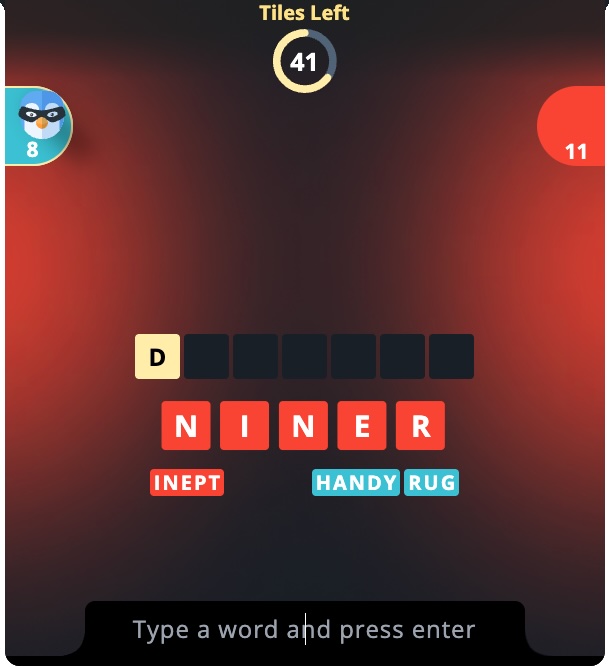
Pilfer Introduction
Pilfer is an online word game from Merriam-Webster that combines vocabulary knowledge with a competitive twist.
Players form words from a shared pool of 60 letter tiles and can strategically “steal” points from opponents.
Matches usually involve anonymous players, but you can also share a link to play with friends. In anonymous games, you won’t know in advance if you’ll be competing against 1, 2, or 3 opponents, which can make games with four players much more frenetic than games with only two.
It’s also possible to play against a computer opponent.
While it doesn’t have a classic predecessor like Scrabble or Boggle, Pilfer fits into the family of modern online multiplayer word games that reward both word skill and tactical thinking.
Rules of Pilfer
In Pilfer, all players play simultaneously in real time, creating words from the communal tile pool. Key mechanics include:
- Form Words: Each word you create scores points equal to its length.
- Steal Points: If another player has already played a word you can extend or “steal,” you gain points while your opponent loses the same number of points.
- Time Pressure: The game moves quickly because all players are active at the same time.
The game ends when all 60 tiles have been played. Because points are transferred during steals, the total combined score of all players never exceeds 60. The winner is the player with the highest score at the end.
Pilfer Strategy
Focus on Longer Words
Longer words score more points and give you more opportunities to steal, so aim to maximize word length whenever possible.
Watch Opponents’ Words
Keep an eye on words already played. Identifying steal opportunities can swing points in your favor.
Prioritize Speed and Accuracy
Because Pilfer is real-time, typing quickly and accurately is critical. Slow input can cause missed steals and lost points, especially in games with multiple opponents.
React, Don’t Track Letters
Unlike Scrabble or Boggle, the tile pool is randomized each game, and harder levels tend to use less common letters. Tracking remaining tiles isn’t possible; focus instead on creating the best words possible with what’s available.
Adjust Strategy for Player Count
Games with more opponents are faster and more competitive. In four-player matches, you may need to act more aggressively and watch the board closely, while two-player games allow for a slightly more measured approach.